
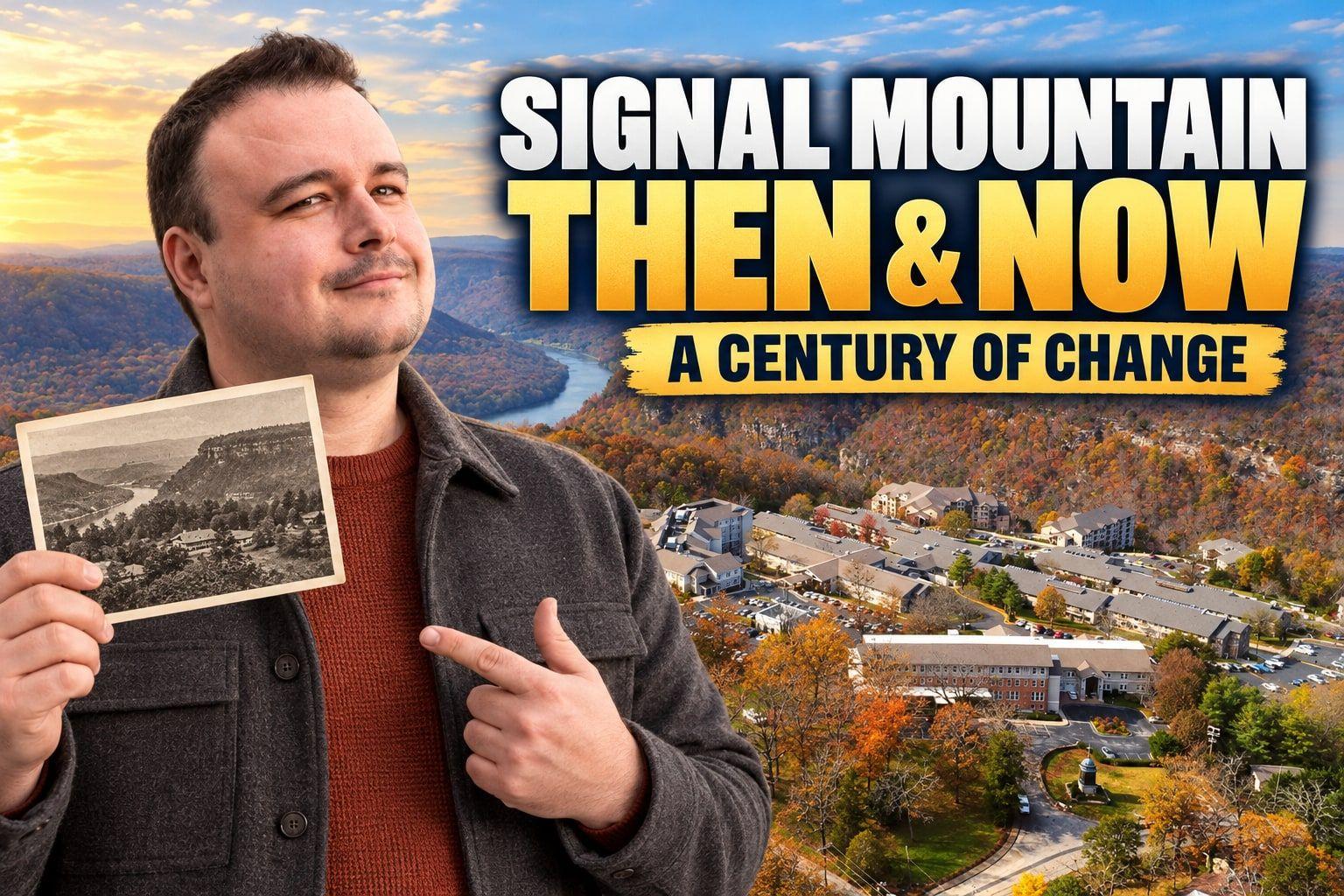
Signal Mountain Then and Now: How the Town Has Changed Over the Last Century
In 1919, the Tennessee Legislature chartered a town that had begun as a mountain retreat above Chattanooga. A twelve-mile electric streetcar line connected the city to the ridge, bringing visitors to a growing community of summer cottages, a hotel, and a golf course.
By 1925, approximately 200 homes had been built, and Signal Mountain was becoming an established year-round residential community.
That's the story behind Signal Mountain then and now: how a mountain resort developed into a town with its own neighborhoods, services, and civic identity while retaining visible reminders of its earliest years.
From Retreat to Real Town
Long before Signal Mountain was incorporated, the ridge overlooking the Tennessee Valley was used for observation and communication.
According to the town's land-use plan, Creek, Cherokee, and other Native American groups are believed to have used Signal Point and nearby locations to communicate with fire and smoke signals.
During the Civil War, Union forces used Signal Point as a communications station in 1863, relaying messages and observing activity in the Tennessee Valley.
By the late nineteenth century, the mountain was attracting visitors for different reasons.
Chattanooga residents sought relief from summer heat and outbreaks of disease in the valley. The higher elevation and cooler conditions made the ridge an appealing seasonal retreat.
Charles E. James became the central figure in the community's early development.
James acquired approximately 4,400 acres around Signal Point and pursued plans for a residential resort community.
In 1913, twelve miles of electric streetcar track connected Chattanooga to Signal Mountain.
That same year, the Signal Mountain Inn opened, offering visitors accommodations and recreational facilities.
The streetcar made the mountain more accessible and supported the development of nearby residential properties.
In 1918, James completed the Signal Mountain Golf Course.
The golf course created an unexpected problem.
Farmers had traditionally allowed livestock to graze on Walden's Ridge, and cattle and other animals continued wandering into the developing community.
The animals were particularly attracted to the golf course.
Residents sought municipal authority to address the problem.
On April 4, 1919, the Tennessee Legislature chartered the Town of Signal Mountain.
One of the new town government's first actions was to prohibit livestock from roaming freely within town limits.
James served as the town's first mayor.
By the time of his death in 1925, approximately 200 homes had been built, many near the Signal Mountain Inn and golf course.
That early development became the area now commonly known as Old Town or Olde Town.
What the Historic District Preserved
The Signal Mountain Historic District preserves an important part of the town's early residential development.
Located near the southern end of Signal Mountain, the district extends roughly along James Boulevard, Brady Point Road, and Signal Point Road.
It contains residential and other historic buildings associated with the community's development during the twentieth century.
The district was listed on the National Register of Historic Places on October 5, 2001.
According to the National Park Service, its architectural significance includes examples of Bungalow/Craftsman and Tudor Revival styles.
These buildings reflect the transition from a seasonal mountain retreat to an established residential town.
The historic district also preserves reminders of Signal Mountain's streetcar era.
Sections of former trolley track remain visible along James Boulevard, and a historic trolley shelter provides another connection to the transportation system that helped the community develop.
The streetcar line is no longer operating, but its surviving features help explain the original layout of the neighborhood.
Other historic buildings have been adapted for new uses.
The former Signal Mountain Inn was acquired by the Alexian Brothers in 1936 and later became part of the Alexian Village retirement community.
The original Signal Mountain Grammar School, constructed in 1926, also became an important community landmark.
Today, the former school building is associated with the Mountain Arts Community Center.
These properties demonstrate how buildings from Signal Mountain's early development have continued serving the community in different ways.
National Register recognition identifies the district's historical and architectural significance.
However, National Register listing alone does not generally restrict private owners from altering their properties when no federal involvement or separate local preservation requirements apply.
Homeowners considering renovations should confirm applicable zoning, permitting, and any local preservation regulations before beginning work.
The Growth That Came Later
Signal Mountain continued developing after its initial resort era.
As automobiles became more common, the streetcar system eventually disappeared, and road access became increasingly important.
The community gradually shifted away from its original identity as a seasonal destination.
Its population increased over the following decades.
According to the town's financial records, Signal Mountain had 979 residents in 1930 and 1,786 in 1950.
By 1980, the population had reached 5,818.
That growth reflected the town's transition into a larger residential community connected to Chattanooga's broader economy.
The 1970s were an important period for municipal development.
The town expanded its civic facilities, including the town center complex, as community needs changed.
Local services and commercial establishments also became increasingly important to everyday life on the mountain.
Pruett's Market developed into a familiar local grocery destination and community gathering place.
Residential development continued beyond the original historic district, creating neighborhoods with different lot sizes, architectural styles, and construction periods.
By 2000, Signal Mountain had 7,429 residents.
The population reached 7,554 in 2010 and 8,852 in the 2020 U.S. Census.
These figures illustrate how the community expanded from a relatively small mountain settlement into an established town with thousands of permanent residents.
Signal Mountain's growth did not occur in a single building boom.
Instead, its housing stock reflects several periods of development, from early twentieth-century cottages and Craftsman homes to mid-century residences and newer construction.
That variety is one reason the town's neighborhoods can feel different from one another.
Why It Still Matters Today
For buyers and homeowners, Signal Mountain's history provides useful context for understanding its housing market.
The Olde Town area contains properties associated with the community's earliest development.
Some homes retain historic architectural details, while others have been renovated or expanded over time.
Newer neighborhoods may offer different floor plans, construction methods, and lot configurations.
Neither older nor newer construction is automatically the better choice.
The right property depends on a buyer's priorities, maintenance expectations, budget, and long-term plans.
Buyers considering older homes should pay particular attention to building condition, renovation history, electrical and plumbing systems, roofing, drainage, and any applicable property restrictions.
Those interested in the historic district should also understand the distinction between National Register recognition and legally enforceable local regulations.
For sellers, a property's historical character may contribute to its appeal, but pricing should still be based on current comparable sales, condition, location, and market demand.
Signal Mountain's development history also helps explain its physical layout.
The original resort community developed around the inn, golf course, streetcar corridor, and nearby residential streets.
Later growth expanded the town beyond that early center.
Today, the combination of established neighborhoods, historic buildings, natural surroundings, and proximity to Chattanooga continues to shape the experience of living on the mountain.
Signal Mountain then and now is a story of a community that changed considerably over the last century while retaining visible connections to its beginnings.
Our team at Choice Homes works across Chattanooga and Signal Mountain, helping buyers and sellers evaluate properties in different neighborhoods and price ranges.
Understanding a home's age, location, condition, and surrounding development can help make those decisions more informed.
You can reach our team at (423) 618-3739 if you have questions about specific properties, historic district considerations, or current Signal Mountain market conditions.
Frequently Asked Questions
When was Signal Mountain officially chartered as a town?
The Tennessee Legislature chartered the Town of Signal Mountain on April 4, 1919.
Before incorporation, the area had developed as a mountain resort and residential community associated with Charles E. James.
A twelve-mile electric streetcar line connecting Chattanooga to Signal Mountain was completed in 1913.
The Signal Mountain Inn opened that same year, and the golf course was completed in 1918.
By 1925, approximately 200 homes had been built.
What is the Signal Mountain Historic District, and where is it located?
The Signal Mountain Historic District is located near the southern end of the town, roughly along James Boulevard, Brady Point Road, and Signal Point Road.
It was listed on the National Register of Historic Places on October 5, 2001.
The district contains historic residential architecture, including Bungalow/Craftsman and Tudor Revival examples, along with surviving features associated with the former streetcar system.
National Register listing recognizes the area's significance but does not automatically impose restrictions on privately funded exterior alterations.
Property owners should verify any applicable local requirements before planning renovations.
How much did Signal Mountain grow over the last century?
Signal Mountain developed from a resort community into an established residential town.
According to the town's historical and financial records, its population included:
• 979 residents in 1930.
• 1,786 residents in 1950.
• 5,818 residents in 1980.
• 7,429 residents in 2000.
• 7,554 residents in 2010.
• 8,852 residents in 2020.
The town experienced substantial residential growth during the twentieth century, particularly as it expanded beyond its original resort-era neighborhoods.
Its present-day housing stock includes properties from multiple development periods, reflecting more than a century of community growth.
Sources
• Town of Signal Mountain — Land Use Plan
• Tennessee Municipal Technical Advisory Service — Signal Mountain Community Profile
• Tennessee General Assembly — Signal Mountain 90th Anniversary Resolution
• National Park Service — Signal Mountain Historic District
• Town of Signal Mountain — Annual Financial Report
• National Park Service — National Register of Historic Places
• Signal Mountain Mirror — Local History
Related reading
• The Oldest Neighborhoods in Chattanooga and the Stories Behind Them
• How Chattanooga Got Its Name: The Cherokee Word Behind the City
• 13 Homebuying Mistakes That Can Haunt You (And How to Avoid Them in Chattanooga)
Homes for Sale
Live listings, updated directly from the MLS.
Ready to Make Your Next Move?
Connect with Choice Homes for a clear plan whether you are buying, selling, or exploring communities across Tennessee and Georgia.