
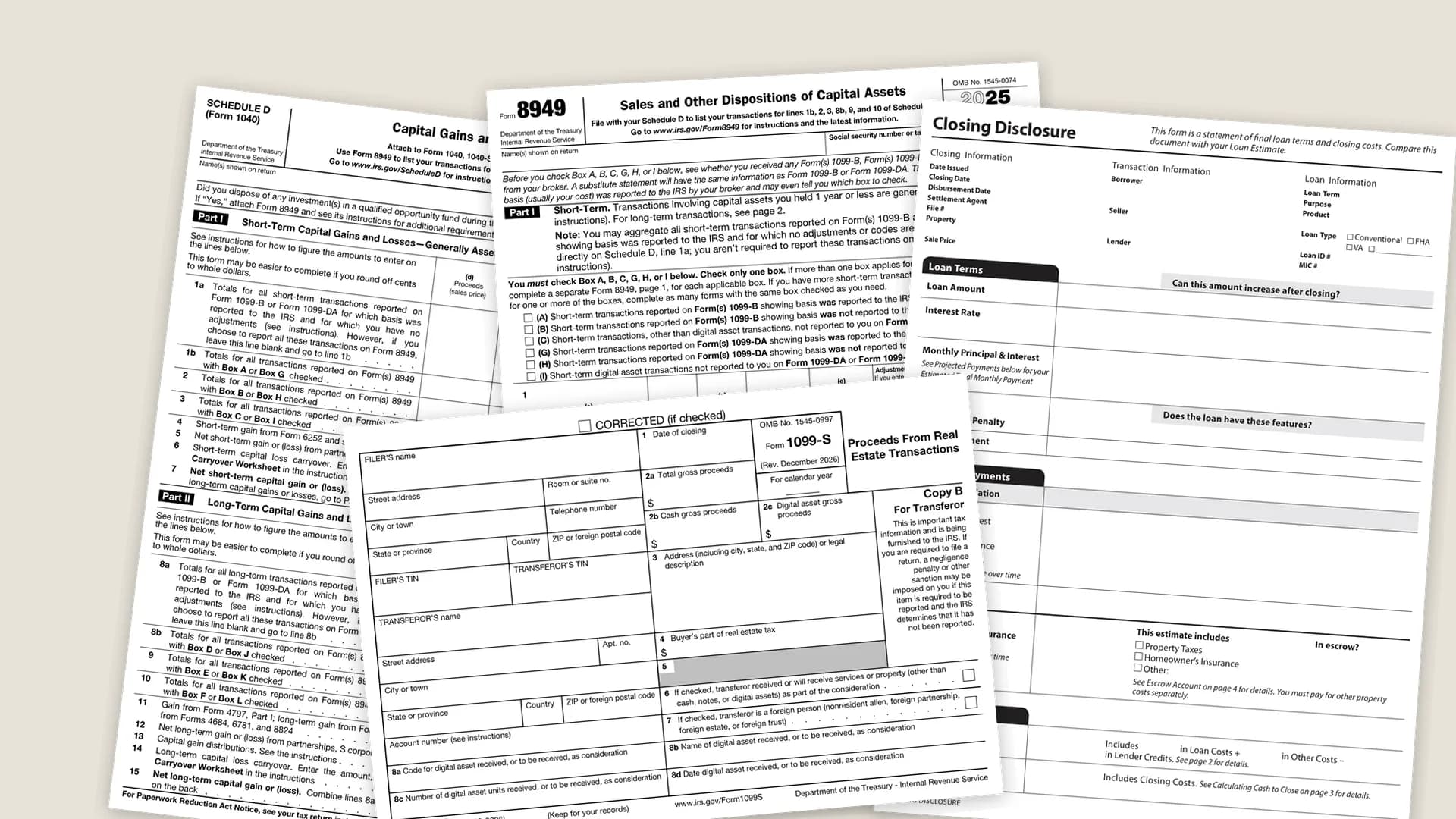
8 Documents You May Need for Tax Filings If You Sold a House
To file taxes after you sold a house, you need 8 documents: Form 1099-S, the sale closing statement, transfer tax receipts, the original purchase settlement statement, home improvement receipts, purchase closing-cost records, IRS Publication 523, and Form 8949 with Schedule D. Together they show your sale price, your cost basis, and whether any capital gains count as taxable income.
We are Choice Homes, a Chattanooga real estate team brokered by eXp Realty, and we believe sellers deserve clear guidance at tax time too. We are not tax advisors, so confirm every number with a tax professional before you file.
The 8 documents at a glance
Before you file, sort the 8 documents into three groups: closing records from the sale, basis records from your purchase, and the IRS forms used to report the sale on your return.
| Group | Documents | What they prove |
|---|---|---|
| Sale closing records | 1. Form 1099-S 2. closing statement 3. transfer tax receipts | Your sale price, gross proceeds, and selling expenses |
| Purchase and basis records | 4. purchase settlement statement 5. improvement receipts 6. purchase closing costs | Your cost basis in the property |
| IRS forms and worksheets | 7. Publication 523 8. Form 8949 and Schedule D | How the gain or exclusion is reported |
Closing documents from the sale
Form 1099-S
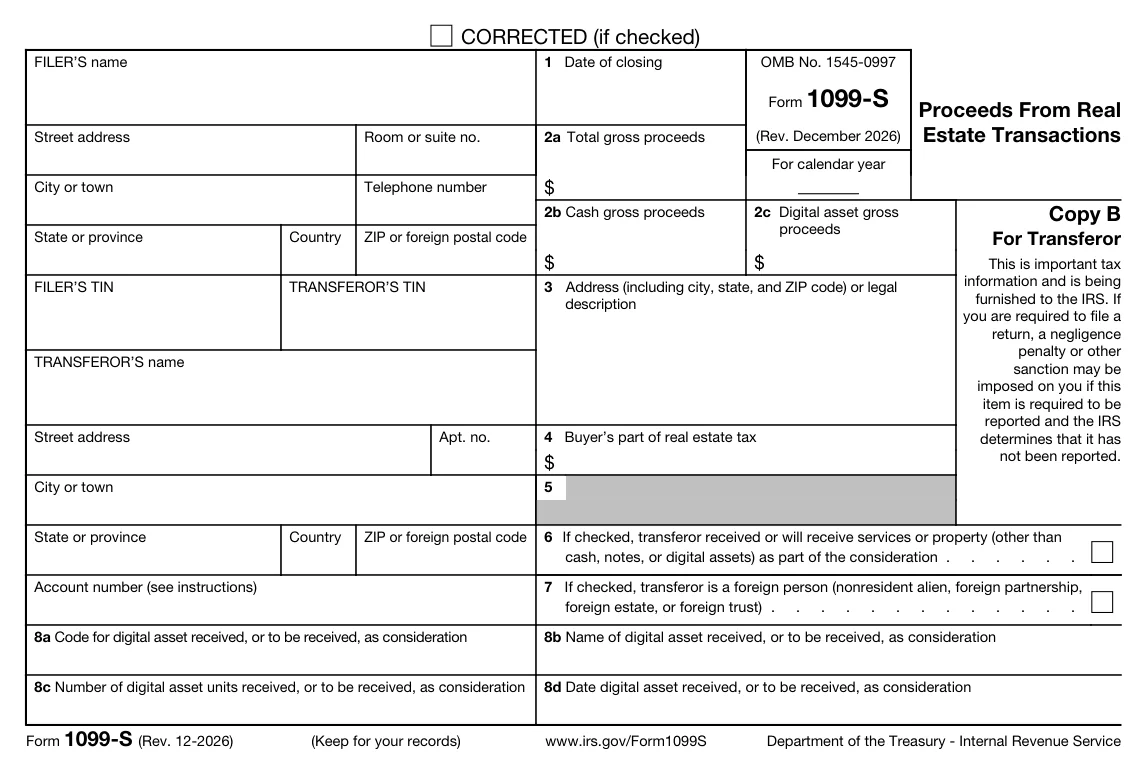
The first group arrives on closing day, and Form 1099-S usually leads it. Form 1099-S, Proceeds From Real Estate Transactions, reports the gross proceeds from your real estate sale to the IRS. The title or settlement company typically issues it with the closing documents you receive at settlement. And the IRS itself will not send it.
You may not receive a 1099-S if your sale met the IRS requirements for excluding the gain. But here's the thing: if you do receive one, you often must report the home sale on your tax return. That holds even if the gain is excludable, because the form shows gross proceeds only.
If an expected 1099-S never shows up, call the settlement company first. A blank copy of the form is also available on the Internal Revenue Service website.
Before you file, compare the gross proceeds on the 1099-S with the sale price on your closing statement. If the figures look wrong, ask the settlement company that issued the form to review it. Receiving a 1099-S does not automatically mean tax is owed.
Sale closing statement (HUD-1 or Closing Disclosure)
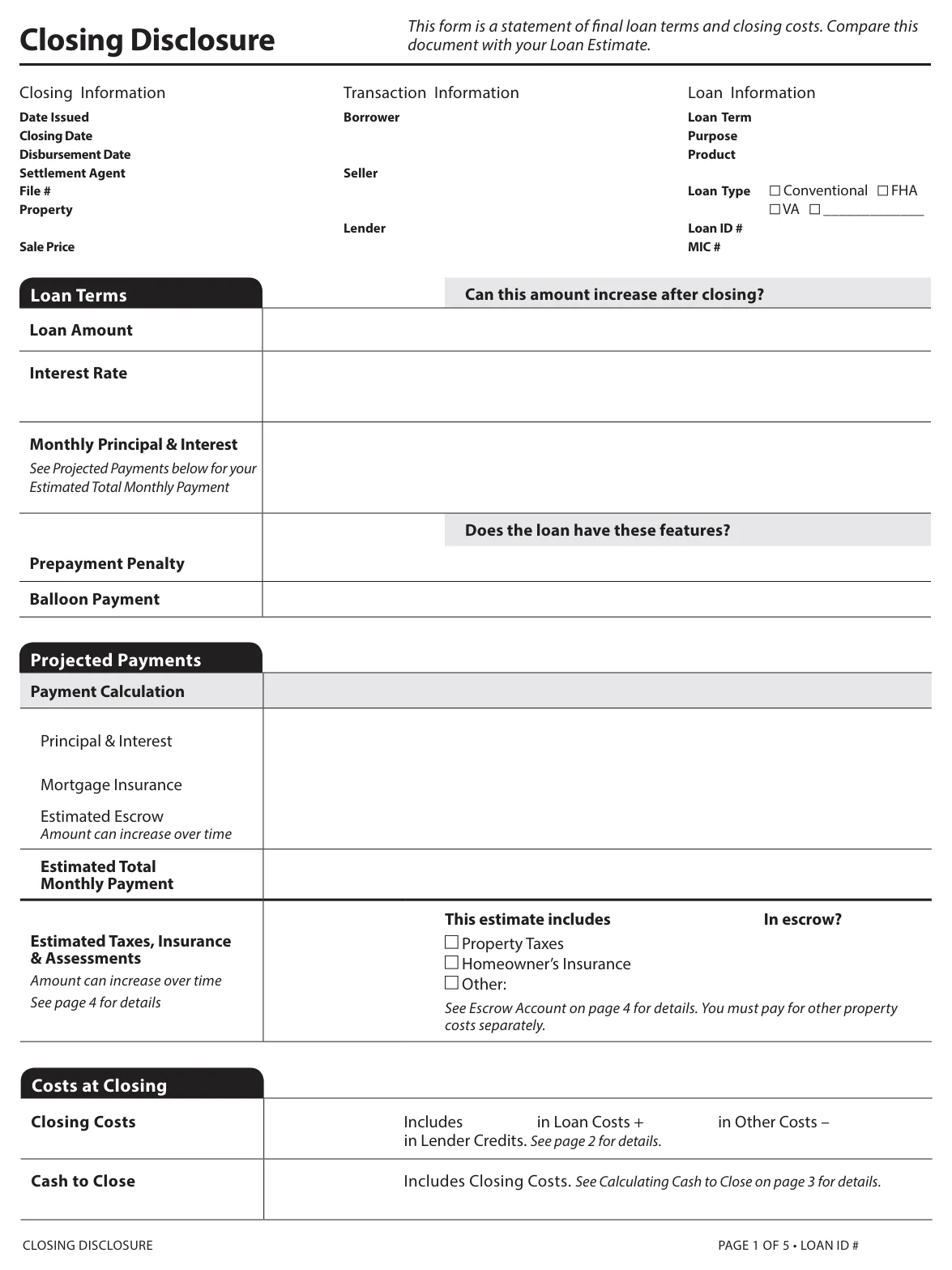
Once the 1099-S is in your folder, the sale closing statement goes right beside it, since it is the receipt for your home sale. It details your final sale price, settlement fees, broker commission, property taxes paid at closing, and other seller expenses. The Closing Disclosure replaced the HUD-1 in 2015 with nearly the same information.
Each selling expense on the statement reduces your gain, which is why it pays to read it line by line before you file.
| Line item | Why it matters for your tax return |
|---|---|
| Sale price | Starting point for the gain |
| Broker commission | Reduces the amount of gain |
| Settlement and title fees | Selling expenses that reduce gain |
| Property taxes paid at closing | Tax information for the year |
Transfer tax receipts
One line on that statement deserves its own receipt: transfer tax. Transfer tax receipts show the local or state transfer taxes paid during the sale. On the selling side, transfer taxes count as a cost of the sale and reduce your proceeds. On the buying side, transfer taxes paid at purchase can be added to your basis. Like sales commissions, transfer taxes on the sale reduce sales proceeds rather than counting as a deduction.
Keep the separate receipt anyway. It is cleaner proof if the IRS ever asks.
Purchase and basis records
Proof matters even more as we move back in time to your purchase. Your cost basis is, in general, the purchase price plus costs of purchase plus improvements. Sale price minus the costs of the sale, minus basis, gives you the amount of gain, which is why these next three records matter so much.
Original purchase settlement statement
The oldest of these, the original purchase settlement statement, establishes your acquisition date and your purchase price. The date sets the duration of ownership for the ownership and use tests, and the price is the first number in your basis.
Buyers and sellers each receive a Closing Disclosure or ALTA Settlement Statement at closing, and this is the buyer's copy. It can also show points paid and property taxes prepaid.
Lost it? Request a copy from the title company or closing attorney that handled the purchase, and ask early.
Home improvement receipts
While that request is out, turn to the years you owned the home. Home improvement receipts prove the cost of major renovations that increase your cost basis. Examples of improvements that increase basis include a new deck or garage, central air conditioning, a lawn sprinkler system, and a new roof or siding.
Repairs are not improvements, so write a short description of each project on its receipt. For DIY work, basis includes materials and permits paid, but not the value of your own labor. Energy tax credits claimed reduce basis.
| Keep | Why |
|---|---|
| Contractor invoices | Proves the cost of each capital improvement |
| Materials receipts for DIY work | Adds material costs to basis |
| Records of energy credits claimed | Reduces basis |
Purchase closing-cost records (title insurance, legal, recording fees)
Seems like a lot of paper already, but improvements are not the only costs that raise basis. Purchase closing-cost records show fees paid when you bought the home that also increase it. These include owner's title insurance, legal fees, recording fees, survey fees, and abstract of title fees.
Most sit on the purchase settlement statement from document 4, so highlight each one there for your tax professional. When unsure whether a record matters, keep it, since you will need it if the IRS audits the sale.
IRS forms and worksheets
IRS Publication 523 (Sale of Home Worksheet)
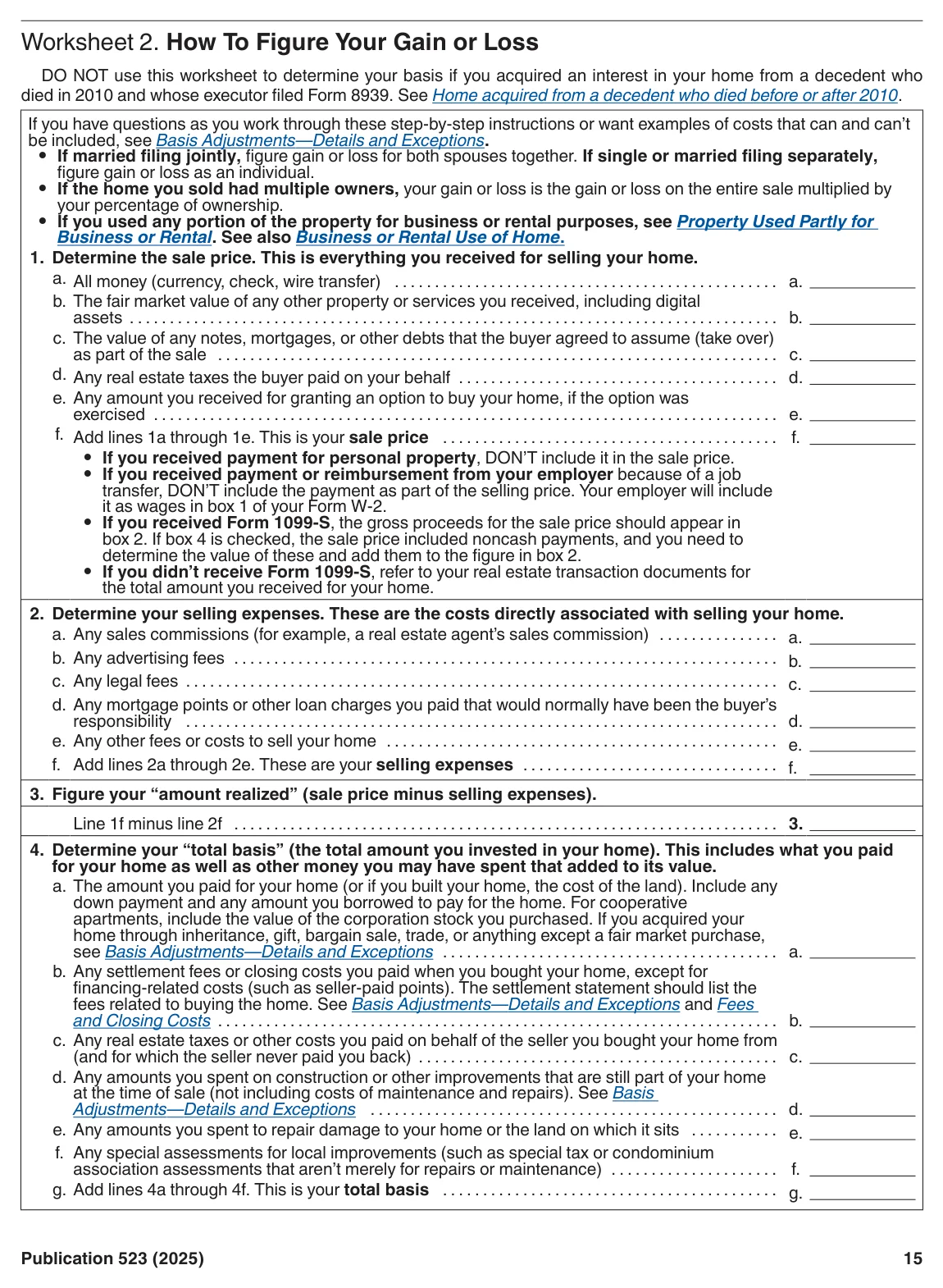
With the sale and purchase records gathered, the IRS paperwork comes next. IRS Publication 523, Selling Your Home, contains the official Sale of Home worksheet used to calculate capital gains or exclusions. It walks through sale price, selling expenses, adjusted basis, and the exclusion test.
Under the Section 121 exclusion, gain on a primary residence can be tax-free up to $250,000 for an individual filer or $500,000 for married couples filing jointly. You generally must have owned the home and used it as your primary residence for at least two of the five years before the sale. And you can claim the exclusion once every two years. A partial exclusion may apply after a work-related or health-related move.
To prove residency, keep records with your name and address, such as utility bills, bank statements, voter registration, and past tax returns.
Form 8949 and Schedule D
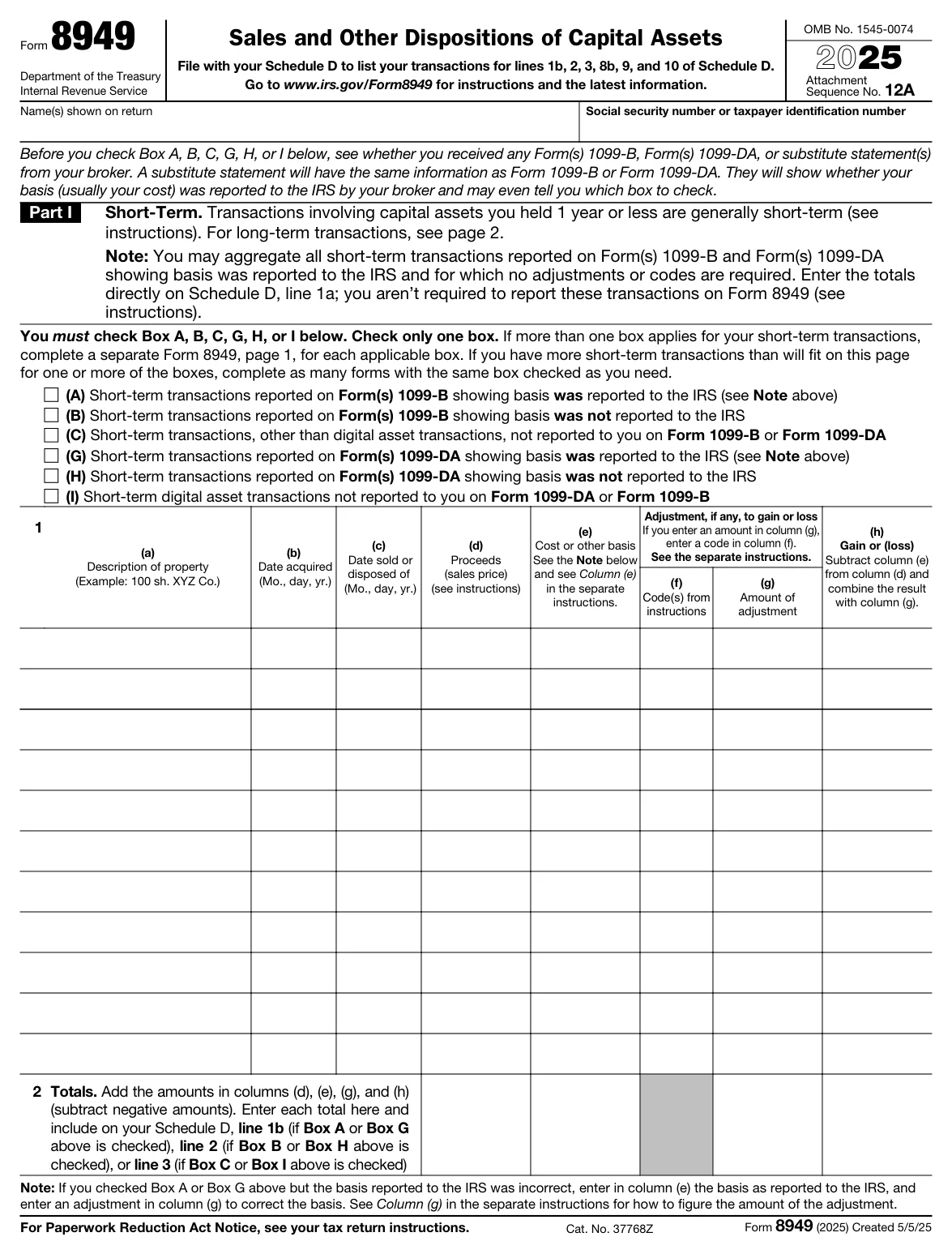
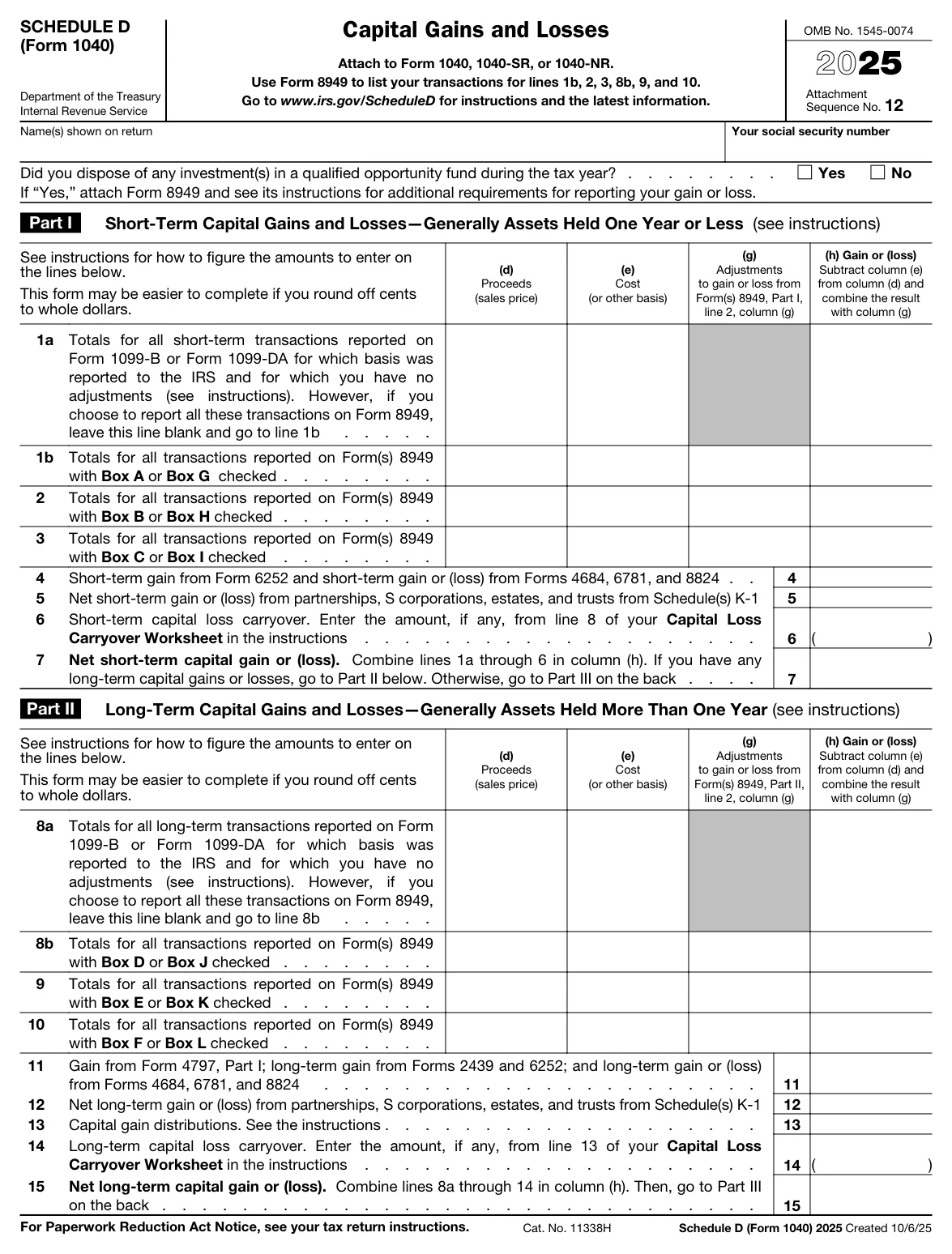
Once the worksheet is done, its numbers carry over to Form 8949 and Schedule D, which report capital gains income from the sale and claim the Section 121 exclusion when reporting is required.
Report on these forms when you received a 1099-S or your gain exceeds the exclusion. Specifically, when no 1099-S arrived and the gain looks fully excluded, ask your tax professional first. Profit on a rental property or vacation home can often be taxed in full, since the exclusion generally covers only a primary residence.
Checklist before you file
Whichever way that decision lands, the order of work stays the same.
- Pull the sale closing documents: the 1099-S, closing statement, and transfer tax receipts.
- Pull the purchase settlement statement and highlight the purchase closing costs.
- Total your improvement receipts and subtract any energy credits claimed.
- Complete the Publication 523 worksheet to see whether the exclusion covers your gain.
- Report on Form 8949 and Schedule D if required, then file your return.
Complete records help you get the right refund, or the right tax bill, the first time you file.
Organize now or at tax time?
The first time is also the easiest time to get organized, which is why we suggest starting the month after closing.
| Approach | Pros | Cons |
|---|---|---|
| Build the checklist right after closing | Records are fresh and easy to request | Takes time during a busy move |
| Wait until tax season | No work now | Missing receipts and basis errors |
Form 1098 and record retention
One more form arrives in a sale year, though it is not among the 8: Form 1098 from your mortgage lender, reporting interest paid while the loan was outstanding, if more than $600. The itemized deduction for mortgage insurance premiums has expired.
The IRS recommends keeping tax returns for at least three years. A general rule of thumb for home sale records: keep returns and supporting documents for 7 to 10 years, and keep closing disclosures, improvement receipts, and purchase price records indefinitely.
FAQ
Those records also answer the questions sellers ask most often.
Do I have to report my home sale if I got a 1099-S?
If you receive Form 1099-S, you often must report the sale on your tax return, even if the gain is excludable.
Will I always receive a 1099-S when I sell a house?
No. If your sale qualifies for a Section 121 exclusion, you may not receive a 1099-S.
Does the exclusion apply to a rental or vacation home?
Generally no. The capital gains exclusion applies to your primary residence.
How long should I keep my home sale records?
Keep closing disclosures, improvement receipts, and purchase price records indefinitely, in case of an audit or a future home sale.
Next step
Every answer above points back to one folder holding all 8 documents. Review it with your tax professional before you file, and if you sold with our Chattanooga team, ask your agent for copies of your closing documents.
Call (423) 243-3198